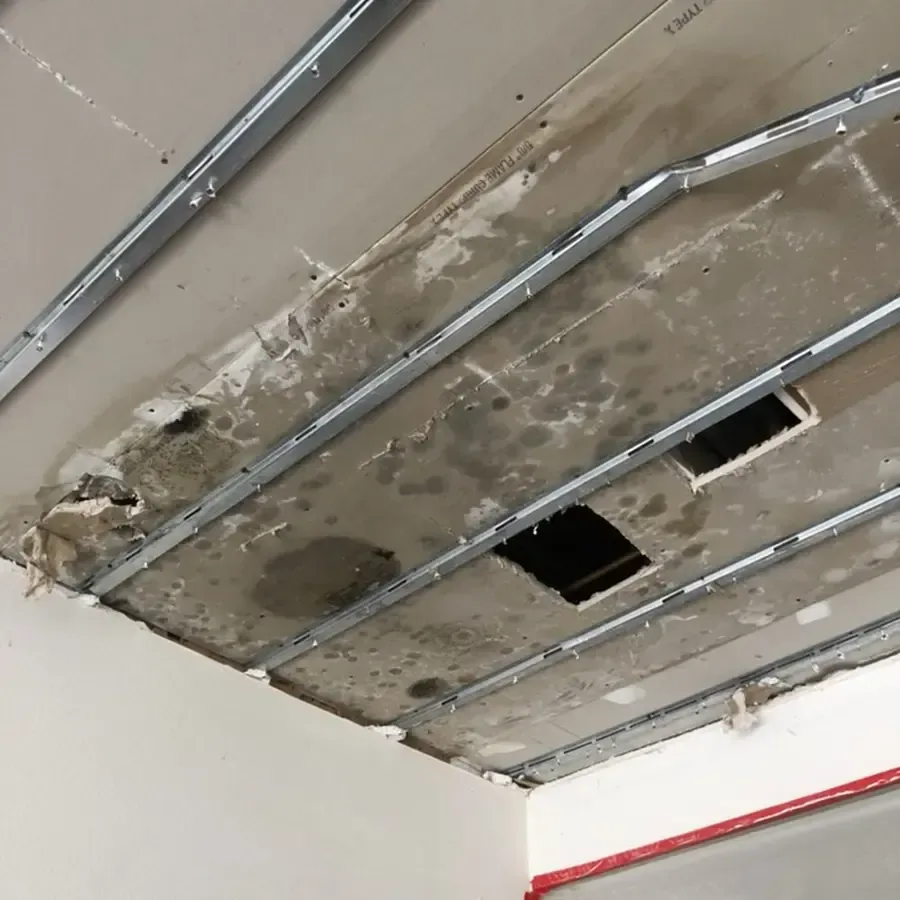
On Thursday night, July 14, 2022, a monsoon storm closed a road, knocked out power and left debris in backyards across Queen Creek. Storms like that can open a roof in ways that only show when the next rain arrives.
Key takeaways
- The July 14, 2022 storm closed the westbound lanes of Ocotillo Road at Sossaman Road, caused multiple power outages and downed poles and trees.
- Monsoon thunderstorms bring most of the town's rain from July to mid-September.
- Wind damage can let rain in later, so a ceiling stain may follow a storm by a long gap.
- Wet insulation is removed rather than dried, and sagging drywall is opened carefully.
- Photos, dates and moisture readings keep the insurance record clear.
What the July 14, 2022 storm left behind
The storm hit on a Thursday night. It closed the westbound lanes of Ocotillo Road at Sossaman Road because of storm damage and caused multiple power outages across the area.
Afterward, field four at Mansel Carter Oasis Park was closed, and crews worked on downed power poles, damaged trees and backyard playsets.
That damage list reads like a roof inspector's checklist: things blown down and things knocked loose.
One storm touched roads, power, parks and yards at once, which shows how widely monsoon wind can reach in a single night.
- Road closure: westbound Ocotillo Road at Sossaman Road.
- Power: multiple outages across the area.
- Park: field four at Mansel Carter Oasis Park closed.
- Yards: downed poles, damaged trees and backyard playsets.
How wind damage lets rain in later
Monsoon thunderstorms bring most of the year's rain here, from July to mid-September. Normals show 8.28 inches a year, with July averaging 1.08 inches and August 1.11 inches.
A gentler second rainy season arrives in winter with Pacific frontal systems. A roof damaged in one storm may be tested again by the next.
Openings that start small
Wind rarely strips a roof in one piece. It lifts an edge, shifts a covering or dents a vent, and the opening is small enough to miss from the ground.
- Roof coverings lifted or shifted by gusts.
- Flashing loosened around vents, skylights and chimneys.
- Impact marks from branches and flying debris.
- Gaps where a storm moved a roof-mounted fixture.
Why the leak shows up late
Water entering at the roof deck first soaks insulation. The ceiling only stains once the insulation is saturated, and that can take a second rain.
In the meantime the wet insulation can rest against the drywall for weeks. That is long enough to stain, sag or grow mold, so a stain after a storm is worth a prompt look.
Reading the ceiling after a storm
A ceiling tells a story before anyone climbs into the attic. The shape, color and timing of a stain point to whether water is still arriving.
A stain near a light fixture deserves quick attention, because water may be moving along wiring paths and framing rather than straight down.
Marking the edge of a stain with a pencil and a date shows whether it is growing. A stain that spreads between rains points to a leak that is still active.
- A stain that grows or darkens after rain points to an active leak.
- Brown rings with dry edges often mean old water that has stopped.
- A bulge or sag means water is pooled above the drywall.
- Drips at a light fixture or vent mean water is traveling along framing.
First steps for a wet ceiling
The goal is to keep water from spreading while the opening is found. A sagging section is best left to a crew, because pooled water can drop all at once.
A call about ceiling leak water damage is the right one when the stain is below living space and the roof opening is unknown.
Ceiling lights and fans are the main electrical concern. Water that reaches a fixture box can energize a wet circuit, so switching off at the panel is safer than flipping a wall switch.
- Move furniture and rugs out from under the stain.
- Set a bucket under any drip and a tarp under a bulge.
- Switch off power to lights and fans on the wet circuit.
- Photograph the ceiling, the date and the weather.
- Keep the family out of rooms with a sagging ceiling.
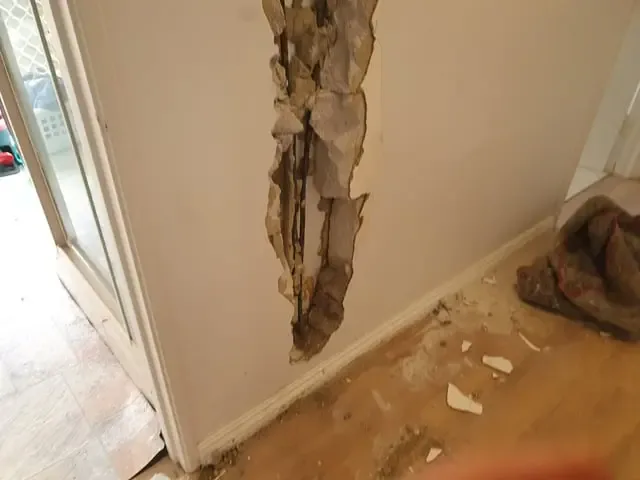
Roof leak cleanup: insulation, drywall and drying
Wet insulation holds water against the ceiling and does not dry well, so it is removed. The drywall is cut back to where readings are normal.
A crew that handles roof leak water damage then dries the joist bays and any wet framing with air movers and dehumidifiers. The Florence roof leak page prints ranges from $1,500 to $3,500 for one ceiling stain and from $3,500 to $6,500 when the room below is wet.
Ceilings are rebuilt only after the framing above them is dry. Closing a wet cavity traps moisture against new drywall.
- Wet insulation is bagged and removed.
- Drywall is cut along straight edges for an easier patch.
- Framing is dried to a dry reference before anything is closed up.
- Roof repair is a separate trade, coordinated so rain does not return.
Documenting a storm loss for the insurer
The storm date helps an insurer connect the roof damage to a covered event. Photos of the roof, the ceiling and the weather that night support the claim.
Readings, a list of removed materials and the repair invoice complete the record. For other storm entry points such as doors and windows, see storm water damage in town.
A roofer's written findings, with photos of the opening, tie the leak to the storm. The crew's moisture map shows how far the water spread.
Preparing a roof before the next monsoon
A storm that missed a house this year can still be the one that finds its weak spot next summer. A little attention before July pays off.
None of this replaces a roofer's inspection, but it helps a homeowner notice trouble early.
- Look over the roof from the ground after every wind event.
- Photograph the roof and ceilings in dry weather for a baseline.
- Trim branches that overhang the roof.
- Check the attic for stains or damp insulation after the first storm of the season.
Questions
Can a roof leak appear long after a storm?
Yes. Insulation can soak up water first, and the ceiling may only stain once it is full, often after a second rain.
Should a ceiling stain wait until the roof is fixed?
No. Wet insulation and drywall keep holding moisture, so drying starts in parallel with the roof repair.
When is the monsoon season in Queen Creek?
Monsoon thunderstorms bring most of the year's rain from July to mid-September. A gentler second rainy season comes in winter.
Does the restoration crew repair the roof?
The crew handles the water damage inside: extraction, removal and drying. The roof itself is repaired by a roofer.
Is wet attic insulation safe to leave in place?
Usually not. Saturated insulation stays wet for a long time and can damage the ceiling below, so it is normally removed.
What if a stain appears but the roof looks fine from the ground?
Small openings are hard to see from below. A roofer can inspect more closely, and moisture readings show where the water traveled.